Admissions Open 2027
PGDM PGPM PGPM-HR

DESIGN. INNOVATE. LEAD.
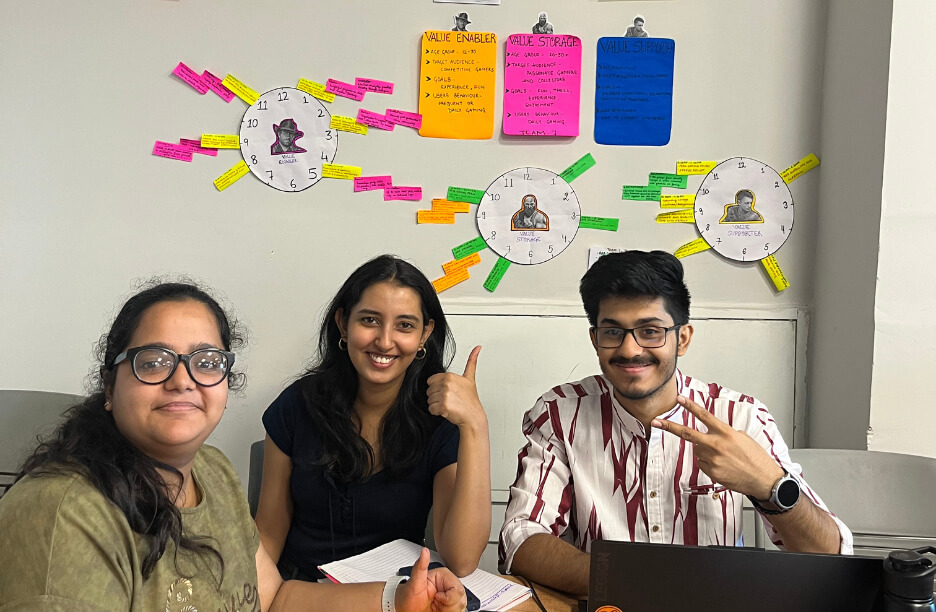
learn through experience

The PGDM curriculum integrates business fundamentals, design thinking, and liberal arts with immersive, real-world learning to prepare you for future-ready leadership.

  • 1,035 Hours

    Core Curriculum: Build expertise in General Management, HR, Finance & Analytics, Operations, and Marketing through an integrated, multi-tiered approach.

  • 1,090 Hours

    Beyond the Classroom: Apply learning through Centers of Excellence, Design Thinking & Liberal Arts immersion, industry projects, student-led initiatives, and global exposure.

Learning Outcomes

The PGDM curriculum blends business fundamentals, design thinking, and liberal arts to cultivate versatile leaders equipped with the skills, mindset, and values reflected in the following outcomes:

  • Demonstrate the ability to apply and integrate the functional areas of business to make sound decisions.

  • Develop competence to identify and solve complex problems using structured, feasible, and creative solutions.

  • Gain intellectual depth through a multidisciplinary approach, critical thinking ability, and experiential learning.

  • Cultivate the sensibility to care about human lives, communities, and the planet in decision making.

  • Exhibit leadership and interpersonal awareness through collaboration, effective communication, and managing organizational change.

Teaching Methods

Experiential Learning-Led Teaching

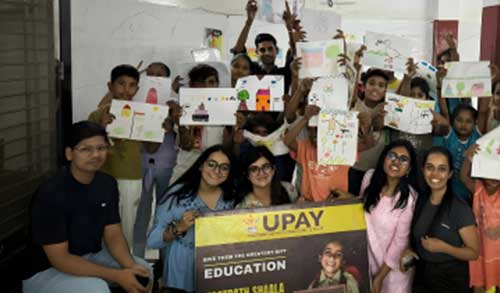
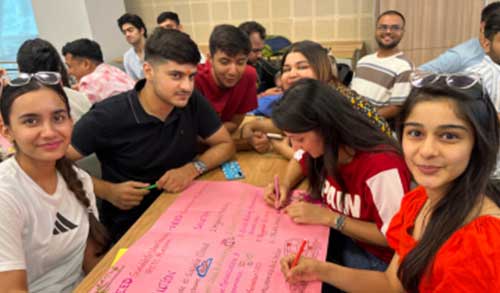
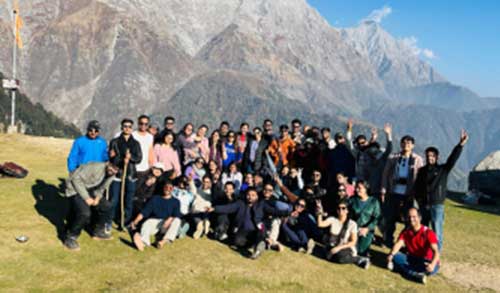
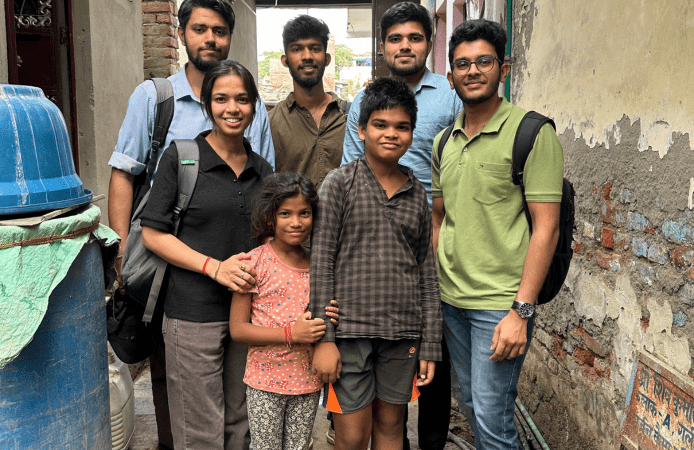
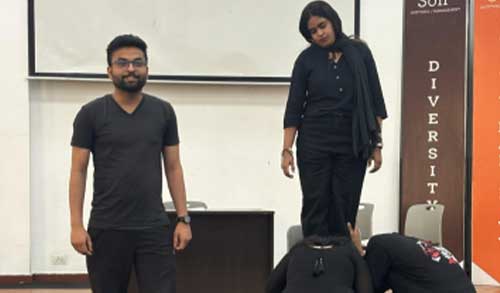
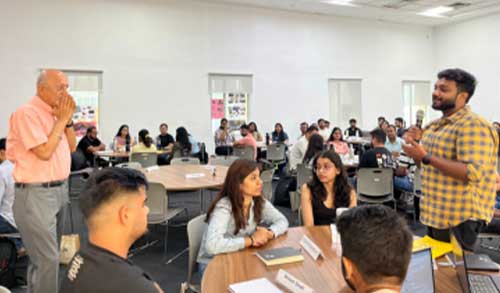
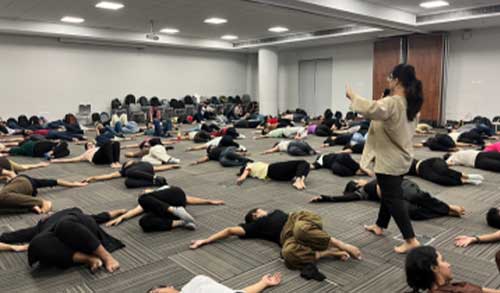
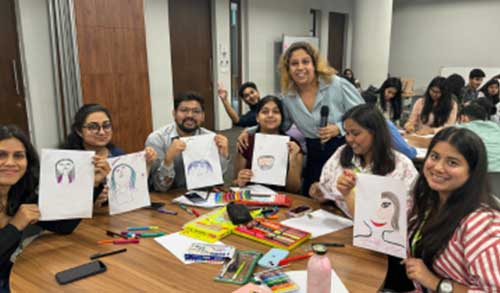
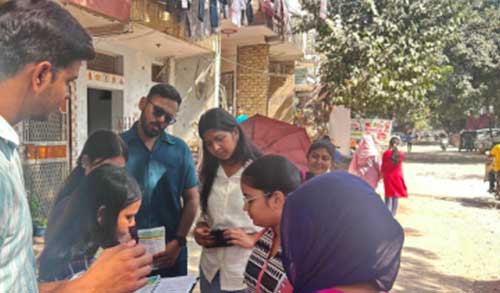
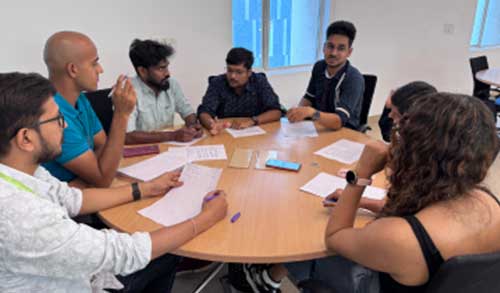
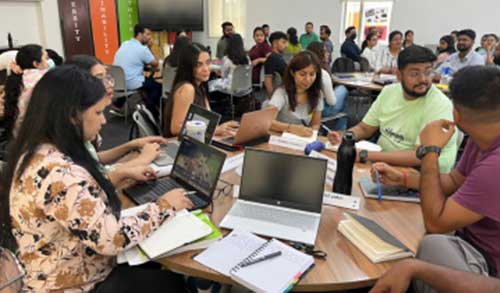
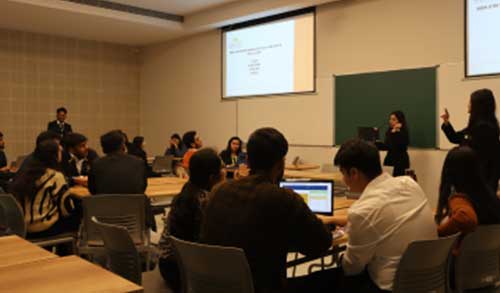
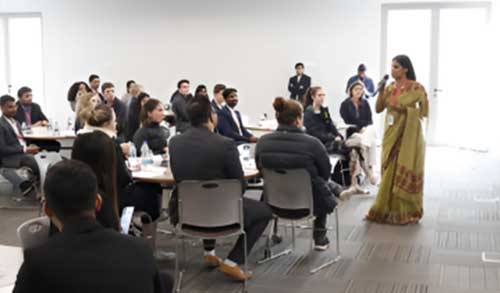
Immersive modules, field projects, and leadership experiences integrate creativity, empathy, and cross-cultural understanding into the learning journey. Students participate in global immersions, rural retreats, innovation projects, and personal development labs.

  • theatre image
    Social Innovation Project
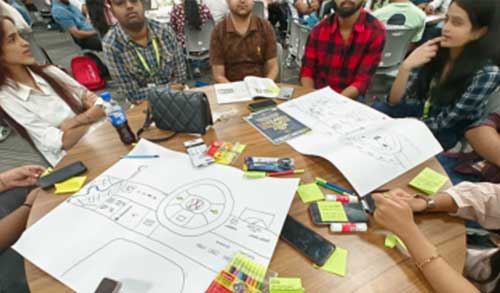
  • Design Thinking Lab
    Design Thinking Lab
  • Himalayan Immersion
    Himalayan Retreat / Rural Immersion
  • social Innovation
    Global Immersion Program
  • Theatre & Ethics
    Theatre & Ethics
  • Self-Leadership Workshops
    Self-Leadership Workshops
  • Yoga & Wellness
    Yoga & Wellness
  • Experiential Fridays
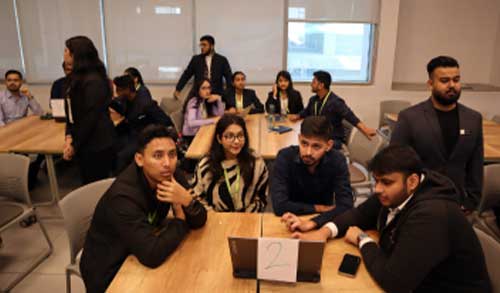
    Experiential Fridays
Industry/project based practices

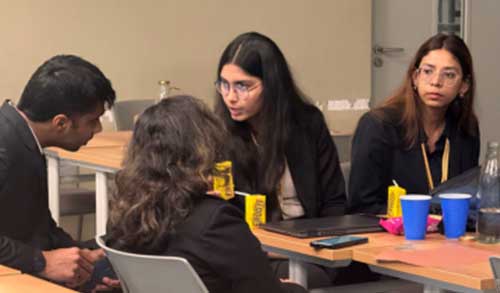
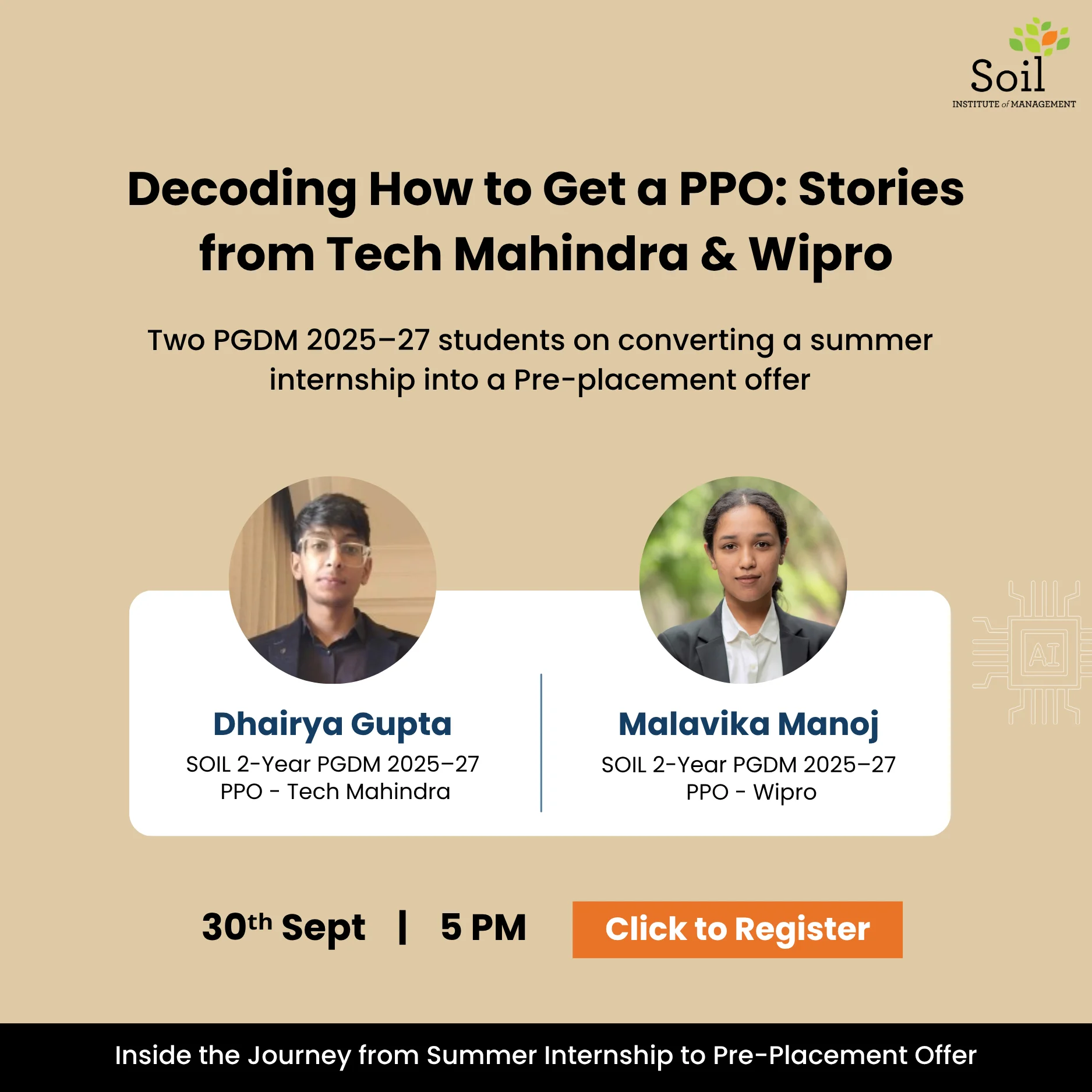
Close engagement with industry leaders through mentorship, guest lectures, field visits, and co-designed learning modules enables students to apply classroom learning in real business environments. Through 2–3 month summer internships after Year 1 and live consulting, entrepreneurial, and innovation-focused projects, students work with corporates, start-ups, and NGOs to solve real problems while developing analytical and creative problem-solving skills.

  • Industry Visits
    1-on-1 Industry Mentorship
  • Industry Visits
    Industry Visits
  • Leadership Talks
    Leadership Talks
  • Summer Internship with corporates
    Summer Internship with corporates, start-ups, or NGOs
  • Community Impact Project
    Community Impact Project
  • Business Innovation Challenge
    Business Innovation Challenge
  • Customer Experience Redesign
    Customer Experience Redesign
Workshop & Bootcamp-Based Teaching

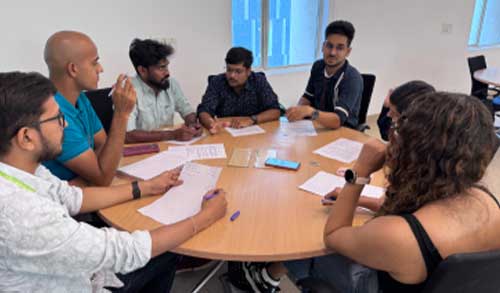
High-intensity, hands-on modules designed to accelerate learning of critical business skills in a condensed time frame. These workshops and bootcamps emphasize problem-solving, collaboration, and practical application, preparing students to tackle real business challenges with confidence.

  • Business Analytics & Decision-Making Bootcamp
    Business Analytics & Decision-Making Bootcamp
  • Financial Modeling & Analysis Workshop
    Financial Modeling & Analysis Workshop
  • Design Thinking & Innovation Sprint
    Design Thinking & Innovation Sprint
Case Method Pedagogy

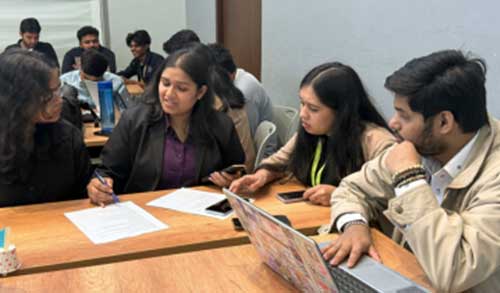
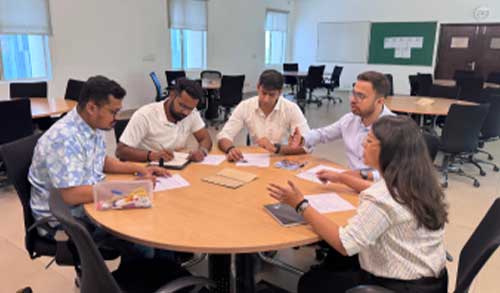
Structured classroom learning through real-world case discussions from Harvard Business School, other global B-schools, and contemporary industry contexts. Faculty lead Socratic-style dialogues that challenge students to analyze complex, cross-functional problems and propose innovative, well-reasoned solutions.

  • Southwest Airlines: Culture, Strategy, and Growth
    Southwest Airlines: Culture, Strategy, and Growth
  • ICICI Bank and Chanda Kochhar: Leadership and Governance Challenges
    ICICI Bank and Chanda Kochhar: Leadership and Governance Challenges
  • The Tata Group: Building and Sustaining a Values-Driven Culture
    The Tata Group: Building and Sustaining a Values-Driven Culture
Simulation-Led Course Delivery

Simulations immerse students in dynamic, competitive environments that demand strategic thinking and data-driven decision-making. These modules develop agility, teamwork, and the ability to operate under pressure.

  • MarkStat – Marketing Strategy Simulator
    MarkStat – Marketing Strategy Simulator
  • Stock Market Simulation
    Stock Market Simulation
  • HR Lab
    HR Lab
  • Capstone Simulation
    Capstone Simulation
Tool-Centric Teaching Approach

Mastery of modern business tools is integrated into the curriculum, ensuring graduates are industry-ready. Students apply tools for analytics, data visualization, and process optimization directly to assignments and projects.

    • Python
    • R
    • Power BI
    • Tableau
    • Advanced Excel
    • AI Tools
    Tool-Centric Teaching Approach

MAJORS & MINORS

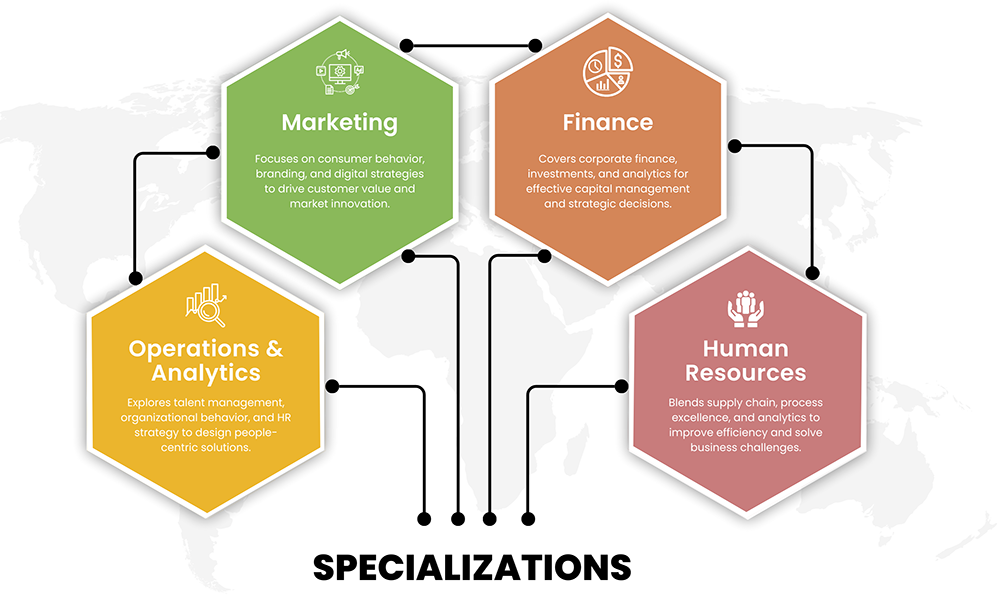
The PGDM program at SOIL empowers you to shape your learning journey by pursuing a Major and, optionally, a Minor. This flexible structure allows you to develop deep expertise in your chosen field while gaining complementary skills from another—aligning your academic focus with your career goals.

Majors and Minors at SOIL go beyond subject mastery. They sharpen your critical thinking, enhance your ability to solve complex business problems, and prepare you to navigate dynamic markets with confidence. Your chosen pathway becomes the lens through which you integrate knowledge, skills, and values—emerging as a versatile, purpose-driven leader.

Majors Offered
  • Marketing
  • Human Resources
  • Finance
  • Operations & Analytics
Minors Offered
  • Marketing
  • Human Resources
  • Finance
  • Operations
  • Analytics
Specializations

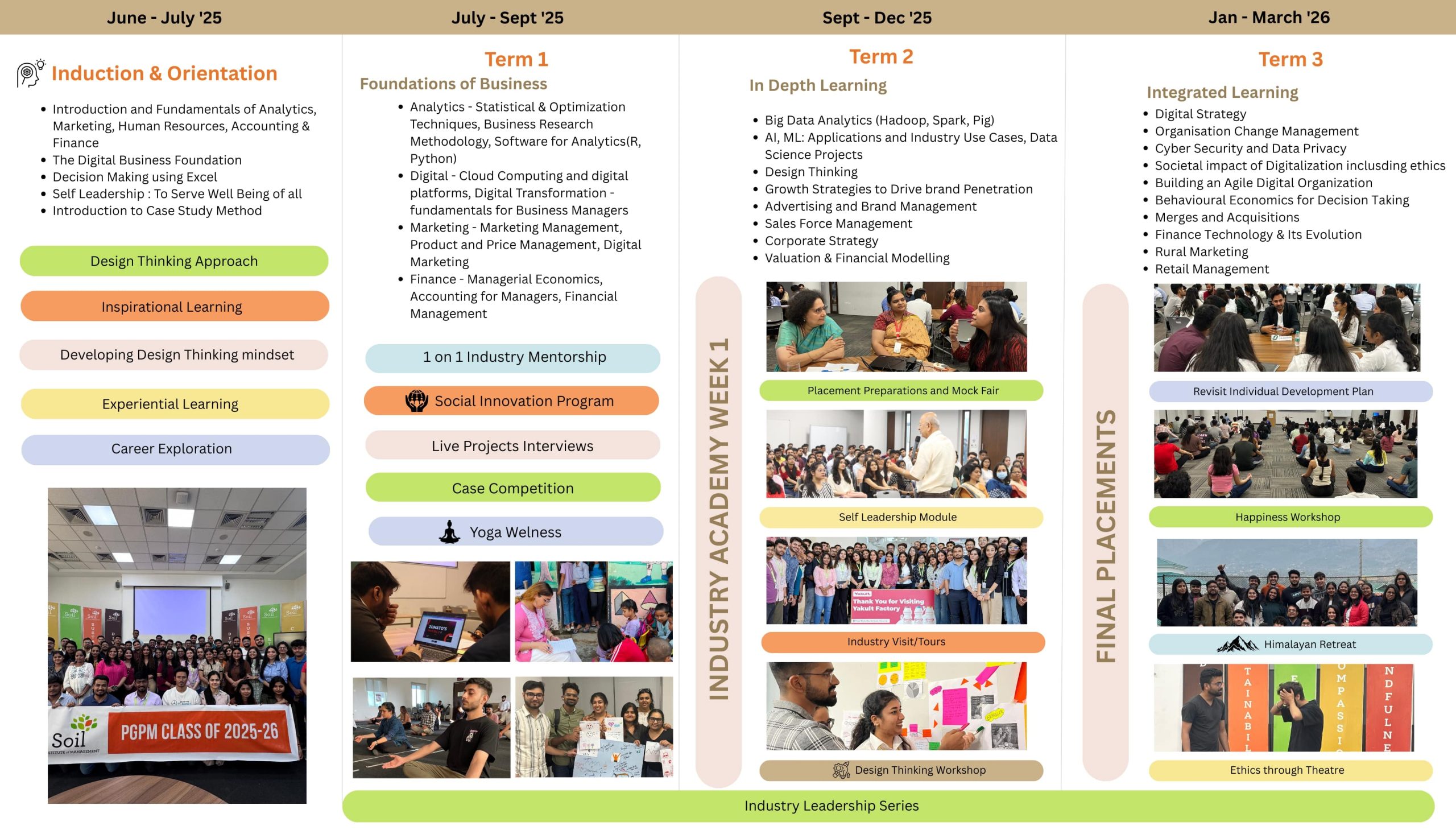
Visual Program Journey

Visual Program Journey

PGDM Curriculum

Our PGDM curriculum is designed to shape future-ready business leaders who thrive in uncertainty and lead with purpose. The six-term program blends core business knowledge, design thinking, liberal arts, and hands-on experiences to foster agility, innovation, and leadership excellence.

Term 1

Building foundational business acumen

  • 420 hours
  • 12-14 Courses

Students begin their journey by grounding themselves in the fundamentals of management. This term emphasizes core concepts in marketing, finance, operations, and organizational behaviour, along with liberal arts and design thinking for holistic thinking. The term fosters curiosity, collaboration, and ethical reflection.


- Read less
Course Name Professor(s) Area Type Credits_(Hours)
Career Training (Exploration) CDS Team Career Development Core 0 (7 hours)
Statistical Models for Decision Making (through R) Dr Bianka Analytics Core 3.0 (30 hours)
Marketing Management - I Dr Jobin Marketing Core 3.0 (30 hours)
Accounting For Managers Dr Mala Finance Core 3.0 (30 hours)
Persuasive Communication-I Dr Shivani General Core 1.5 (15 hours)
Data Analysis using Excel Dr Somesh & Dr Jana Analytics Core 1.5 (15 hours)
Managerial Economics Dr Vani General Management Core 3.0 (30 hours)
Organizational Behaviour Dr Vidya Human Resources Core 3.0 (30 hours)
Experiential Fridays OSA Experiential Core 0 (10 hours)
Sociology Prof Garima Yadav Liberal Arts Core 1.0 (10 hours)
Design Thinking Mindset Prof Navin Design Thinking Core 2.0 (20 hours)
Sourcing Inspiration Prof Navin General Core 1.0 (10 hours)
Emerging Technologies Prof Parul Khurana Analytics Elective 1.0 (10 hours)
Yoga and Wellness for Healthy Life Prof. Susie Roy Liberal Arts Core 0 (5 hours)
No results found.
swipe icon
+ Read more

Term 2

Strengthening analytical & operational skills

  • 400 hours
  • 11-13 Courses

Students develop a deeper understanding of business functions and decision-making frameworks. Focus areas include data analysis, financial reporting, supply chain, and people management. Sessions are enriched with case-based discussions, design sprints, and immersive learning techniques.


- Read less
Course Name Professor(s) Area Type Credits_(Hours)
Career Training (Developing a Plan) Ms Neerja Career Development Core 0 (10 hours)
Prescriptive Analytics through Optimization techniques Prof Dindayal Analytics Core 1.5 (15 hours)
Social Innovation Project Prof Navin Experiential Core 3.0 (50 hours)
Operations and Supply Chain Management Prof Navin Operations Core 3.0 (30 hours)
Social and Cultural Anthropology Prof Pushpendra Liberal Arts Core 1.0 (10 hours)
Marketing Management – II Prof Ranjita Marketing Core 2.0 (20 hours)
Persuasive Communication-II Prof Shivani General Core 1.5 (15 hours)
Design Thinking in Social Innovation Prof Teesta Design Thinking Core 2.0 (20 hours)
Business Research Methods Prof Vani Analytics Core 3.0 (30 hours)
Human Resource Management Prof Vidya / Pragya Human Resources Core 3.0 (30 hours)
Corporate Finance Prof Vineeta Finance Core 3.0 (30 hours)
Entrepreneurship and New Venture Creation TBD Entrepreneurship Core 1.5 (15 hours)
No results found.
swipe icon
+ Read more

Term 3

Applying learning through immersive experiences

  • 370 hours
  • 10-12 Courses

This term focuses on experiential learning. Students participate in design thinking bootcamps, community-based projects, and theatre-led ethics modules. Emphasis is placed on integrating classroom knowledge with real-world problem-solving. The term concludes with a mandatory summer internship, bridging academia and industry.


- Read less
Course Name Professor(s) Area Type Credits_(Hours)
Business Analysis for Emerging Technologies (BAET) Mr. Gaurav Analytics Elective 3.0 (30 hours)
Digital & Social Media Analysis (DSMA) Ms. Kanika Elective Elective 3.0 (30 hours)
Career Training (Preparation for Internship) Ms. Neerja Career Development Core 1.0 (10 hours)
Business Design Ms. Teesta Design Thinking Core 2.0 (20 hours)
Project Management Prof Chandan Operations Core 2.0 (20 hours)
Financial Statement Analysis (FSA) Prof Manpreet Finance Elective 3.0 (30 hours)
Talent Acquisition & Management (TAM) Prof Pragya Human Resources Elective 3.0 (30 hours)
Psychology for Managers Prof Pragya Liberal Arts Core 1.0 (10 hours)
Management Accounting Prof Ranjani Finance Core 1.5 (15 hours)
Marketing Research (MR) Prof Sanjib Marketing Elective 1.5 (15 hours)
Stock Market Simulation Prof Udayan General Management Core 1.0 (10 hours)
Data Visualisation (Power BI) Prof Vani Analytics Core 1.5 (15 hours)
Corporate Governance, Sustainability & Business Ethics Prof Vidya Iyer General Management Core 1.5 (15 hours)
Legal Aspects of Business TBD General Management Core 3.0 (30 hours)
AI Week - 2 TBD Career Development Core 0 (20 hours)
Himalayan Retreat / Rural Immersion TBD Experiential Core 2.0 (50 hours)
Industrial Relations & Labor Laws (IRLL) TBD Human Resources Elective 3.0 (30 hours)
AI Week - 1 TBD Career Development Core 0 (20 hours)
Entrepreneurship and New Age Business Models TBD Entrepreneurship Core 1.5 (15 hours)
No results found.
swipe icon
+ Read more

Term 4

Exploring specialization pathways

  • 320 hours
  • 10-12 Electives

Students begin customizing their learning journey by choosing elective courses in their areas of interest — Marketing, Finance, Analytics, or Human Resources. Courses are designed in collaboration with industry leaders and emphasize application through simulations and labs.


- Read less
Course Name Professor(s) Area Type Credits_(Hours)
Consumer Behaviour (CB) Dr. Ranjita Marketing Elective 3.0 (30 hours)
Brand and Product Management (BPM) Prof Anees Marketing Elective 3.0 (30 hours)
Predictive Analytics & Machine Learning (PAML) Prof Anirudh Analytics Elective 3.0 (30 hours)
Business Valuation and Financial Modelling (BVFM) Prof Manpreet Finance Elective 3.0 (30 hours)
Pricing Strategies - Products & Services (PS) Prof Mrinal Marketing Elective 3.0 (30 hours)
Cross Cultural and Global Management (CCGM) Prof Pragya Human Resources Elective 3.0 (30 hours)
Preparation for Selection Interviews (CDP) Prof Shivani Career Development Core 0 (30 hours)
Summer Internship TBD Experiential Core 6.0 (60 hours)
People Analytics (HRA) TBD Analytics Elective 3.0 (30 hours)
Big Data & Cloud Computing (BDCC) TBD Analytics Elective 3.0 (30 hours)
Corporate Tax Planning (CTP) TBD Finance Elective 3.0 (30 hours)
Management of Banks and Financial Services (MBFS) TBD Finance Elective 3.0 (30 hours)
Securities Analysis and Portfolio Mgmt. (SAPM) TBD Finance Elective 3.0 (30 hours)
Psychometrics & Competency Profiling (PCP) TBD Human Resources Elective 3.0 (30 hours)
HR Measurement and Audit (HRMA) TBD Human Resources Elective 3.0 (30 hours)
No results found.
swipe icon
+ Read more

Term 5

Deep diving into chosen domains

  • 310 hours
  • 8-10 Electives

Specialization-based learning continues with deeper exploration of chosen domains. Students engage in live industry projects, research assignments, and advanced case analysis. Leadership labs and cross-functional exposure are key elements of this term.


- Read less
Course Name Professor(s) Area Type Credits_(Hours)
Integrated Marketing Communication (IMC) Dr Ranjita Marketing Elective 3.0 (30 hours)
Marketing Analytics (MA) Prof Anees Analytics Elective 3.0 (30 hours)
Deep Learning & NLP (DL&NLP) Prof Anirudh Analytics Elective 3.0 (30 hours)
Sustainability in Supply Chains (SSC) Prof Chandan Operations Elective 1.5 (15 hours)
Multichannel Customer Management (MCM) Prof Jobin Marketing Elective 3.0 (30 hours)
Use of AI and Generative AI in Business Prof Madhav Analytics Core 1.5 (15 hours)
Services Marketing (SrM) Prof Mrinal Marketing Elective 3.0 (30 hours)
Performance Management (PM) Prof Nitu Human Resources Elective 3.0 (30 hours)
Total Quality Mgmt. - Lean and Six Sigma (TQM) Prof RKS Operations Elective 1.5 (15 hours)
Sales and Distribution Management (SDM) Prof Sanjib Marketing Elective 3.0 (30 hours)
HR Consulting and Advisory Skills (HCAS) Prof Tulika Human Resources Elective 1.5 (15 hours)
Organizational Development & Change (ODC) Prof Vidya Human Resources Elective 3.0 (30 hours)
Financial Analytics (FA) TBD Analytics Elective 2.0 (20 hours)
Service Operations Management (SOM) TBD Operations Elective 2.0 (20 hours)
Logistics & Warehouse Management (LWM) TBD Operations Elective 2.0 (20 hours)
Global Supply Chains & Logistics (GSCL) TBD Operations Elective 2.0 (20 hours)
Management Control Systems (MCS) TBD General Management Core 2.0 (20 hours)
Fintech and Alternative Investment Funds (Fintech) TBD Finance Elective 2.0 (20 hours)
No results found.
swipe icon
+ Read more

Term 6

Integrating learning through capstones and leadership projects

  • 305 hours
  • 7-9 Courses/Projects

The final term is designed for integration and transformation. Students work on business simulations, capstone projects, and strategic challenges. Focus is on leadership readiness, managing organizational change, and stepping into future business roles.


- Read less
Course Name Professor(s) Area Type Credits_(Hours)
Strategic Retail Management (SRM) Dr Anees Marketing Elective 3.0 (30 hours)
Marketing Metrics (MktMtr) Dr Jobin Marketing Elective 1.5 (15 hours)
Sustainable Finance and ESG (SFE) Dr Udayan Finance Elective 3.0 (30 hours)
Financial Risk Management (FRM) Mr Tarun Kahar Finance Elective 3.0 (30 hours)
Consulting Skills Prof Anil Sachdev Leadership Elective 2.0 (20 hours)
Corporate Strategy Prof Arvind Nair Management and Strategy Core 2.5 (25 hours)
Business Simulation Prof Chandan General Management Core 1.5 (15 hours)
Procurement & Sourcing Management (PSM) Prof Chandan Operations Elective 1.5 (15 hours)
Business Planning & Forecasting (BPF) Prof Gaurav Analytics Elective 3.0 (30 hours)
Pillars of Inspired Leadership through Theatre Prof Lushin Dubey General Core 2.5 (25 hours)
Strategic Financial Management (SFM) Prof Manpreet Finance Elective 3.0 (30 hours)
B2B Marketing (B2B) Prof Mrinal Marketing Elective 3.0 (30 hours)
Design & Systems Thinking Prof Paveen Soni General Core 2.5 (25 hours)
People Analytics (PA) Prof Pragya Human Resources Elective 3.0 (30 hours)
Learning & Development (L&D) Prof Pragya Human Resources Elective 3.0 (30 hours)
Compensation & Benefits (C&B) Prof Pragya Human Resources Elective 3.0 (30 hours)
Human Resource Development (HRD) Prof Pragya Human Resources Elective 3.0 (30 hours)
Human Resource Information System (HRIS) Prof Pragya Human Resources Elective 1.5 (15 hours)
International Marketing (IM) Prof Ranjita Marketing Elective 3.0 (30 hours)
Advance Social Media for Business (ASMB) Prof Sanjib Marketing Elective 3.0 (30 hours)
Supply Chain Analytics (SCA) Prof Somesh Analytics Elective 3.0 (30 hours)
Diversity, Equity and Inclusion (DEI) Prof Sreya Human Resources Elective 1.5 (15 hours)
Finance for Human Capital Management (FHCM) Prof Vidya Human Resources Elective 1.5 (15 hours)
HR LAB (HRL) Prof Vidya Human Resources Elective 3.0 (30 hours)
Business Innovation & Entrepreneurship Prof Vineeta Entrepreneurship Core 1.5 (15 hours)
Mergers and Acquisitions (M&A) Prof Vineeta Finance Elective 3.0 (30 hours)
International Finance and Trade (IFT) TBD Finance Elective 3.0 (30 hours)
Capstone Simulation TBD Management and Strategy Core 2.5 (25 hours)
No results found.
swipe icon
+ Read more

FAQs

How does SOIL's PGDM differentiate from a traditional MBA?

SOIL's PGDM is built around five interconnected curriculum pillars - core management, Liberal Arts, Design Thinking, the Career Development System (CDS), and Social Innovation - rather than a purely functional, discipline-siloed approach typical of traditional MBA programs.

The program is explicitly designed with a longer time horizon in mind: rather than optimizing only for placement-day skills, courses are structured to shape the kind of manager a student becomes 3-5 years into their career, when people-management and judgment matter more than transactional execution.

How does SOIL balance practical and theoretical learning?

Every course is required to include an industry interface component, for a 20-hour course, typically 2-3 hours are devoted to guest lectures or in-class simulations led by industry experts, making this a near-mandatory feature of every elective.

Beyond individual courses, practical exposure is reinforced through Academic Industry Weeks (AI week 1 and AI week 2), cohort-based industry visits, and short live/academic projects, ensuring theoretical grounding is consistently paired with applied, real-world context.

How is the SOIL PGDM curriculum kept relevant to industry?

Curriculum relevance is maintained through direct industry interfaces built into every course, dedicated Academic Industry Weeks that expose students to live industry practice, and Academic Area Advisory Councils that help shape and validate specialization offerings.

The program also pursues certification partnerships (such as with KPMG for analytics) and is gradually expanding into emerging areas like consulting, reflecting ongoing efforts to track where industry demand is heading.

How is Design Thinking integrated throughout the SOIL PGDM program?

Design Thinking (DT) runs through the program as one of its five core curriculum pillars, rather than being confined to a single course. It follows a three-stage integration model that builds students' capability progressively across the PGDM journey.

Practically, this includes tools and methods such as empathy mapping and customer personas, alongside an increasing AI-first approach to problem-solving, equipping students to apply design-led thinking across functional domains, not just in dedicated DT coursework.

Can students customise their learning journey during the PGDM program?

Yes. While every student selects a major, SOIL doesn't offer a general PGDM track but instead, students shape a customised path within its specialisation framework. Choices are floated at the end of Term 2, with the first major formally offered in Term 3, timed so students head into their summer internship with a clear sense of the domain they want to explore.

Students can shape their journey through several combinations across the 14 total elective courses:

  • 9 courses in one domain = a major
  • 5 courses in a second domain = a minor
  • Fewer than 5 courses in a second area (e.g., 3) = counted as a general minor, not a domain minor

This allows for combinations like 9+5, 10+4, 11+3, or a full 14+0 single major. Students cannot split evenly across two domains (e.g., 7+7) — one domain must anchor their 9-course major. Choices must be finalised by the end of Term 4, after which switching becomes difficult due to how credits have already been allocated.

What kind of industry exposure is integrated into the PGDM curriculum?

Industry exposure runs through the program at multiple levels:

  • Within courses: Every course includes an industry interface, for a 20-hour course, around 2-3 hours are typically devoted to industry-led lectures or in-class simulations. This is a near-mandatory element of every elective.
  • Academy Industry Weeks (AI week): In Term 2 (around November), AI week 1 exposes every first-year student to five core domains i.e Analytics, Marketing, Finance, Operations, and Consulting, with a full day dedicated to each, helping students understand roles, tools, and trends before choosing electives. In Term 3 (around January), AI week 2 goes deeper, with 3–4 days focused on the student's chosen domain, each combining an industry speaker with a simulation, case study, or applied project.
  • Industry visits: Each AI week concludes with cohort-specific company visits aligned to that domain, giving students direct exposure to real management practices.
  • Leadership Series and Experiential Fridays: These provide some of students' earliest touchpoints with industry leaders and practices from the start of the program.

What skills can students expect to develop through SOIL's PGDM curriculum?

The program is designed to build both transferable and functional skills:

Transferable skills

  • Analytical thinking, developed through the Design Thinking course and case-based pedagogy
  • Leadership and communication, built through experiential projects and public engagements
  • Resilience and interpersonal skills, reinforced through the rigorous Career Development System (CDS)

Functional / hard skills

  • A strong analytical foundation for all students through advanced Excel, SQL, and business intelligence tools, with more advanced AI and deep learning options available to those who opt in
  • Domain-specific expertise depending on specialisation, for example, financial modelling, security analysis, and portfolio management in Finance; incident reporting and grievance handling in HR; and proposal and contract writing in Sales
  • Certification partnerships (including with KPMG for analytics) that add industry-recognised credentials to select specialisations

How does experiential learning improve the overall PGDM learning experience?

Experiential learning at SOIL is intentionally designed to develop the whole person, not just professional competencies. It draws on Howard Gardner's theory of the nine multiple intelligences, with workshops mapped to different intelligence types such as numerical, kinaesthetic, and linguistic intelligence, so students can discover strengths and interests beyond the standard MBA toolkit.

Examples include:

  • Creative and therapeutic workshops such as dance and pottery
  • The Reading Club, which has helped participating students build reading speed and cognitive ability
  • Morning Circle sessions, which build confidence and public speaking comfort by helping students move past shyness and inhibition

The goal is for students to leave with a fuller sense of self - their attitudes, interests, and strengths supporting long-term personal growth rather than just immediate placement readiness.

How does the six-term curriculum support progressive learning throughout the PGDM program?

The six-term structure builds progressively:

  • Term 2: AI week 1 exposes students to all five core domains (Analytics, Marketing, Finance, Operations, Consulting) before any specialisation decisions are made
  • End of Term 2: Students begin selecting their major/minor path
  • Term 3: The first formal major is offered, timed just ahead of the summer internship; AI week 2 provides deeper, domain-specific immersion for the student's chosen area
  • Terms 3–6: The full elective basket (14 courses) is completed across these terms, allowing students to build toward their 9-course major and up to a 5-course minor

This progression is designed to move students from broad domain awareness, to informed specialisation choice, to deep, applied expertise.

How does SOIL's multidisciplinary curriculum prepare students for long-term career growth?

SOIL's curriculum is intentionally built around five interconnected pillars - core management, Liberal Arts, Design Thinking, Career Development System (CDS), and Social Innovation — designed to develop students from multiple angles rather than through management theory alone.

The program's explicit philosophy is to prepare students not just for placement, but for who they become 5 years after graduating. Courses like anthropology and psychology, for instance, are framed as being less immediately useful on day one of a job and more valuable once a graduate begins managing teams. Similarly, courses on mental health, wellness, and conflict management are designed to support students at the stage in their careers when people-management - not just technical execution - becomes central to their role.

SOIL measures this through what it calls a “transformation index,” tracked across two horizons: from entry to graduation, and from graduation out to 5 years. This reflects a deliberate design choice to build not just job-ready graduates, but well-rounded future managers - which is part of why the school says its curriculum resonates with its recruiter advisory board.

What if someone has an internship in one specialisation but wants to switch to another?

Switching a major/minor is permitted only until the student is in Term 4, after that point, there typically isn't enough runway left in the elective calendar to complete the required 9-course major in a new domain. As stated completed 9 courses is a must for a Major.

whatsapp