<img height="1" width="1" style="display:none" src="https://www.facebook.com/tr?id=1200130323366352&amp;ev=PageView&amp;noscript=1">
×
Early App. Deadline: 10 October 2026 for PGPM & PGPM-HR | Admissions Open 2027
PGDM PGPM PGPM-HR
soil logo
All Programs

Post Graduate Diploma in Management (PGDM)

Duration
24 Months
Location
Manesar, New Gurgaon
Format
Full Time
Commencement
June 2027

Quick Links

Curriculum Admissions Fees FAQs Placements Batch Profile International Immersion CDS Calendar Life at SOIL Attend an Admissions Event Check Program Eligibility

Post Graduate Program in Management (PGPM)

Duration
12 Months
Location
Gurgaon
Format
Full Time
Commencement
May 2027

Quick Links

Curriculum Admissions Fees FAQs Placements Batch Profile International Immersion CDS Calendar Life at SOIL Attend an Admissions Event Check Program Eligibility

Post Graduate Program Management - Human Resources (PGPM-HR)

Duration
12 Months
Location
Gurgaon
Format
Full Time
Commencement
May 2027

Quick Links

Curriculum Admissions Fees FAQs Placements Batch Profile International Immersion CDS Calendar Life at SOIL Attend an Admissions Event Check Program Eligibility
About us
About Spirituality Founder Message Accreditation & Associations Industry Consortium
Leadership
Governing Board Leadership Council SOIL Advisory Board PGDM Academic Advisory PGPM-HR Academic Advisory
Media
Newsroom Event Media Kit
Global Partnerships
Annual Events
ILC Deekshanta SIP SOIL Premier League Karma Rasoi Annual Alumni Meet Himalayan Retreat
Faculty
Faculty Members International Publications Books Written Conferences
Centers
Centers Centers Of Entrepreneurship Centers for Social Innovation Center For Leadership & Human Values Center of Design Thinking and Innovation
Immersions
Experiential Learning Industry Immersion
Careers
Careers
Office of Careers Careers Team CDS Recruitment Process Alumni
Batch Profile
PGPM PGPM HR PGDM
Reports
PGPM PGPM HR PGDM
Jobs@SOIL
Blogs
Soil
About us
About Spirituality Founder Message Accreditation & Associations Industry Consortium
Leadership
Governing Board Leadership Council SOIL Advisory Board PGDM Academic Advisory PGPM-HR Academic Advisory
Media
Newsroom Event Media Kit
Global Partnerships
Annual Events
ILC Deekshanta SIP SOIL Premier League Karma Rasoi Annual Alumni Meet Himalayan Retreat
Blogs
Faculty
Faculty Members International Publications Books Written Conferences
Centers
Center for Entrepreneurship Center for Social Innovation Center for Leadership & Human Values Center of Design Thinking and Innovation
Immersions
Experiential Learning Industry Immersion
Careers
Careers
Office of Careers Careers Team CDS Recruitment Process Alumni
Batch Profile
PGPM PGPM HR PGDM
Reports
PGPM PGPM HR PGDM
Jobs@SOIL
All Programs

Post Graduate Diploma in Management (PGDM)

Duration
24 Months
Location
Manesar, New Gurgaon
Format
Full Time
Commencement
June 2027

Quick Links

Curriculum Admissions Fees FAQs Placements Batch Profile International Immersion CDS Calendar Life at SOIL Attend an Admissions Event Check Program Eligibility
Download Brochure
Download Placement Reports
Apply Now

Post Graduate Program in Management (PGPM)

Duration
12 Months
Location
Gurgaon
Format
Full Time
Commencement
May 2027

Quick Links

Curriculum Admissions Fees FAQs Placements Batch Profile International Immersion CDS Calendar Life at SOIL Attend an Admissions Event Check Program Eligibility
Download Brochure
Download Placement Reports
Apply Now

Post Graduate Program Management - Human Resources (PGPM-HR)

Duration
12 Months
Location
Gurgaon
Format
Full Time
Commencement
May 2027

Quick Links

Curriculum Admissions Fees FAQs Placements Batch Profile International Immersion CDS Calendar Life at SOIL Attend an Admissions Event Check Program Eligibility
Download Brochure
Download Placement Reports
Apply Now
X
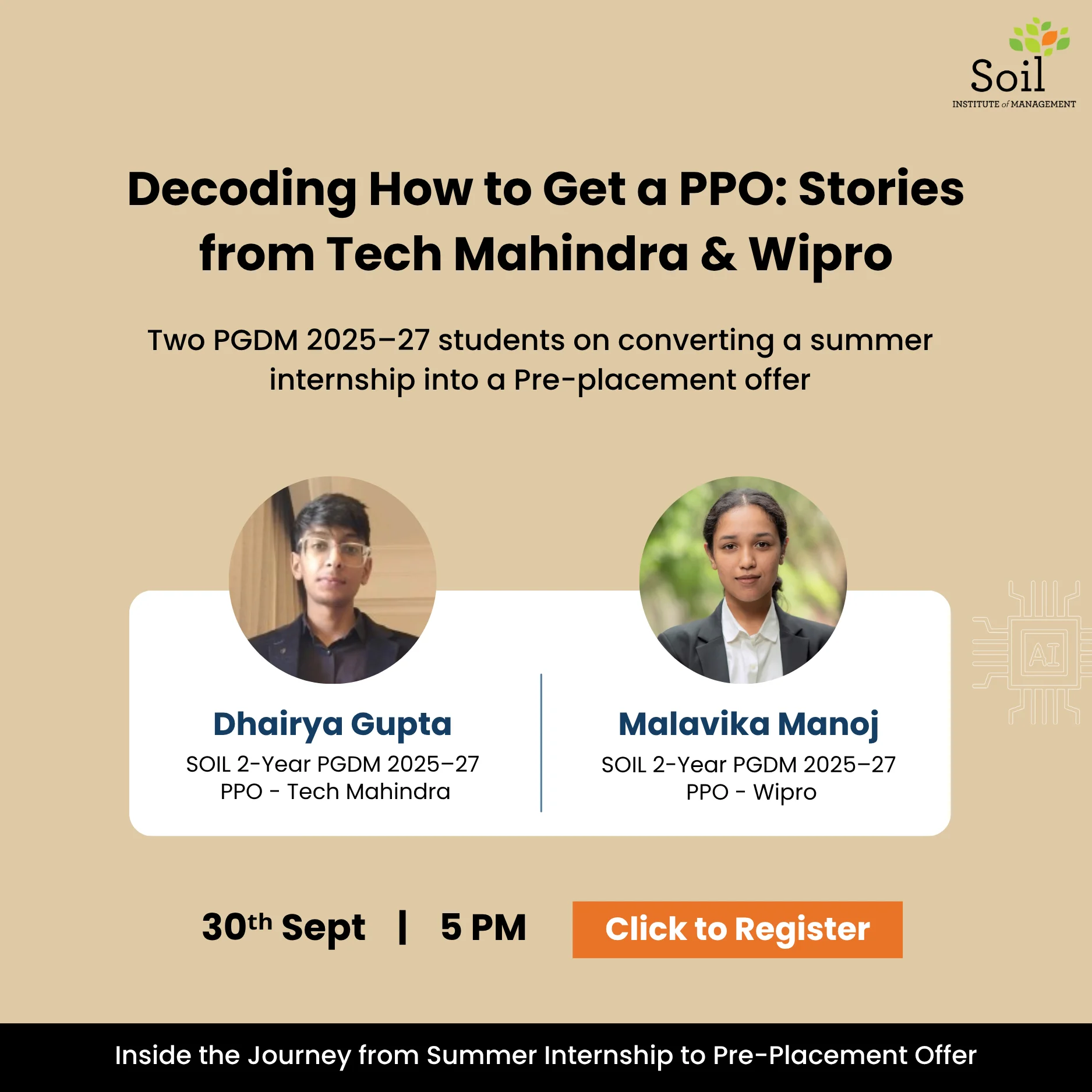
Webinar - Decoding How to Get a PPO: Stories from Tech Mahindra & Wipro
Posts By
  • Admissions Office
  • Faculty Desk
  • Industry Insights
  • Innovation & Design Thinking
  • Leadership & Management
  • PGDM
  • Student Careers
  • Student Journey
  • Student Life
Topics
  • 1 Year MBA
  • 2 Year MBA
  • Admissions
  • Analytics
  • B School
  • Big Data
  • Board
  • Business Design
  • Candidates
  • Career
  • Careers
  • Curriculum
  • Demand
  • Design Thinking
  • Experiences
  • Experiential Learning
  • Finance
  • Global Exchange
  • Growth
  • HR
  • Industry Network
  • International
  • Interview
  • Journey
  • Leaders speak
  • Leadership
  • Learning
  • Management
  • MBA
  • MBA in HR
  • MBA in Human Resource Management
  • One Year Full Time MBA Program
  • One Year MBA
  • One Year MBA in India
  • Opportunities
  • Part time programs
  • Personal Interview
  • PGDM
  • PGDM in Business Design
  • PGPM
  • PGPM - Human Resource
  • PGPM HR
  • Placements
  • Post Graduate Diploma in Management
  • Post Graduate Diploma in Management in Business Design
  • Post Graduate Program in Management
  • Post Graduate Program In Management - Human Resource
  • Pre MBA
  • Preparation
  • Ranking
  • Skills
  • SOIL Days
  • Specialization
  • Technology
  • Transformation
  • Two Year MBA
  • Two Year MBA in India
Audience
  • 1 Year MBA
  • 2 Year MBA
  • Corporates
  • Executive Programs
  • HR
  • HR Programs
  • Part Time Programs
  • PGDM
  • PGPM
Industry
  • Analytics
  • Education
  • Finance
  • HR
Year
  • 2026
  • 2025
  • 2024
  • 2023
  • 2022
  • 2021
  • 2020
  • 2019
  • 2018
  • 2016
  • 2015
  • 2014
Popular Posts
12 Tips To Apply At Soil – From The Pgdm Director For Admissions

12 Tips To Apply At Soil – From The Pgdm Director For Admissions

Read More
MBA vs. PGDM: Understanding the Difference

MBA vs. PGDM: Understanding the Difference

Read More
One Year MBA in India

One Year MBA in India

Read More
What Is The Future Of Design Thinking In Business?

What Is The Future Of Design Thinking In Business?

Read More
PGPM Vs PGDM: Which One Should You Opt For

PGPM Vs PGDM: Which One Should You Opt For

Read More
  • MBA in the Age of AI: What Should Students Look for in an MBA program?

    28 Sep 2026
    • admin
    Share

    You’re applying to an MBA in 2026. By the time you graduate, AI will have been reshaping management work for years.

    The question is whether your MBA will prepare you for that workplace — or leave you learning on the job.

    AI in MBA education is no longer just about adding an AI course. It is about how students learn to use AI across management subjects.

    This creates an unusual problem: the MBA you choose now could leave you underprepared for the work you will actually do.

    If you’re choosing between programmes, you need a way to distinguish between those treating AI as a marketing checkbox and those genuinely integrating it into how students learn management.

    The difference will shape your early years more than you might expect.

    What does an AI-enabled MBA actually look like? What does an AI-enabled MBA actually look like?

    An MBA can offer a course on AI without changing how students learn management.

    A marketing class might use AI to analyse customer research.

    A finance class might use it to test predictions.

    An operations class could examine demand patterns. 

    A strategy class could compare different business scenarios.

    The point is not to make every management subject about AI. 

    It is to give students practice using AI while solving the kinds of problems managers already face. This is also where business-school research is moving. A 2026 framework from AACSB, GMAC and Inspire Higher Ed examined AI initiatives across 84 participating institutions.

    It looks at AI literacy, subject-specific applications, responsible AI, faculty development and AI-supported teaching.

    ai_checkbox_vs_integration

    The shift matters because an effective MBA AI curriculum should connect AI with core management subjects rather than treat it as a standalone topic.

    If AI can produce the analysis, what should managers learn?

    The business knowledge paradox

    AI can produce a forecast, summarise research, compare options. That does not mean business knowledge matters less. It means it matters differently.

    A finance manager receiving three AI-generated forecasts doesn’t struggle to produce numbers, they struggle to understand which assumptions matter and which forecast actually fits the business.

    A strategy team asking AI to compare markets still needs to understand competition, regulation and the company’s capability to operate there.

    The skill employers increasingly need is not “produce the analysis.” It is “decide whether this analysis is worth acting on.” This is not learned by taking an AI course. It is learned by practising these decisions alongside working with AI tools

    assessment_framework_questions

    GMAC’s 2026 Corporate Recruiters Survey found that AI-tool skills are among the areas growing in importance for business-school graduates. Problem-solving and strategic thinking also remain highly valued by employers.

    For students, that makes AI integration in an MBA more than a curriculum question. It becomes a question of workplace readiness.

    Microsoft’s 2026 Work Trend Index points to a similar shift. Among surveyed AI users, quality control of AI output and critical thinking were among the human skills most often identified as becoming more important. Most respondents said they view AI output as a starting point rather than a final answer.

    AI can produce the analysis. Business knowledge helps a manager decide what that analysis means.

    Students still need finance, marketing, operations and strategy. They also need opportunities to apply those subjects while working with AI.

    The useful question is whether a student can explain why the task matters, what the result means and what the business should do next.

    How could AI change the early years of a management career?

    For many young professionals, early career learning happens through routine work.

    They collect research, prepare reports, clean data and build spreadsheets. These tasks may seem basic, but they expose people to how businesses work.

    AI is beginning to take some of this work.

    Anthropic’s Economic Index found that, in its observed Claude usage, AI use leaned towards augmentation rather than automation. About 57% of observed tasks involved AI working with people, while 43% involved direct task automation

    early_career_learning_shift

    If AI does some of the work, where does early-career learning happen?

    This matters for management education because routine work often provides the context needed for bigger decisions.

    A consultant learns about an industry while gathering research. A marketer learns about customers while analysing campaign data. A finance professional learns how a business works while building and reviewing financial models.

    If AI handles more of these tasks, graduates may reach higher-level work sooner. They may also have fewer opportunities to learn through repetition.

    Microsoft’s 2025 Work Trend Index found that 83% of surveyed leaders expected AI to help employees take on more complex and strategic work earlier in their careers.

    That could change what employers expect from new MBA graduates.

    They may be asked to interpret an analysis rather than prepare it. They may be expected to suggest an experiment rather than compile the report. They may need to explain a recommendation before they have spent years doing the underlying work manually.

    This creates a new challenge for MBA programs.

    If routine work becomes less common, some of that learning may need to move into the classroom. Projects could ask students to use AI for part of the work, then interpret and defend the result.

    This differs from a traditional case study because the ambiguity is part of the exercise. Students have to work with an AI-generated output rather than simply analyse a finished case.

    Can the classroom provide the experience AI may remove?

    An AI-enabled MBA can give students practice with the full decision process.

    A student might use AI to analyse a market, then identify gaps in the analysis.

    A finance project could provide several AI-generated scenarios and ask students to test the assumptions before choosing one.

    A marketing assignment could move beyond campaign analysis and ask students to decide which experiment the company should run next.

    The aim is not to predict which jobs AI will automate.

    It is to prepare students for a workplace where the path from doing the work to making the decision may become shorter.

    If AI can produce the answer, what should an MBA assess?

    AI can now help produce a case analysis, presentation or market report.

    That creates a problem for management education.

    If a student can use AI to produce the final answer, the answer alone tells us less about what the student understands.

    The more useful assessment may sit behind the answer.

    The more useful assessment may sit behind the answer.

    A student analysing a new market could use AI to gather information and compare competitors.

    The assessment could then ask:

    • Why did you choose these sources?
    • Which assumptions did you question?
    • What information was missing?
    • Why did you reject one recommendation?
    • What would you do differently with better data?

    These questions test what an AI-generated report cannot show on its own.

    They show whether the student can frame a problem, assess evidence and defend a business decision.

    AACSB’s work on AI in business education points towards changes in teaching and assessment as AI becomes part of learning. Its 2026 framework also looks at AI integration across teaching, learning and institutional practice.

    For students, this changes what a good MBA project might look like.

    An AI-ready programme can give students opportunities to use AI openly, explain how they used it and take responsibility for the recommendation they make.

    The goal is not to prevent students from using AI. It is to make sure the learning cannot be reduced to the answer AI produced.

    What should students look for in an AI-ready MBA? 

    An MBA in the age of AI is not about becoming a technical expert. It is about understanding how AI in MBA education can help you make better decisions when AI is part of the work.

    Students should look for opportunities to use AI across business functions while strengthening the skills needed to evaluate its output. This could mean using AI to analyse customer data, compare market opportunities or generate financial scenarios, then deciding what the analysis actually means for the business.

    The value of an MBA will also depend on how well students learn through practice. As AI takes on more routine analysis, projects can give students opportunities to work with imperfect information, challenge assumptions and defend their recommendations.

    The goal is not to graduate knowing every AI tool. It is to graduate knowing how to think, decide and lead when AI is part of the job.

    FAQs
    • How can students use AI for MBA studies? 

      AI for MBA students can support research, data analysis, scenario testing and other coursework. They still need to evaluate the output, question assumptions and decide what the result means for the business.

    • Do MBA students need coding skills to learn AI?

      Coding can be useful for roles in analytics, product management and technology. Many MBA roles require a working understanding of AI tools, data and AI-generated outputs instead.

    • How can I check if an MBA program teaches AI well?

      See course structure, projects and assessments. Faculty profiles and industry activities can also show where students encounter AI during the program.

    • Should AI be a separate subject in an MBA?

      A separate AI course can cover concepts and tools. Other subjects can show how businesses use AI for tasks such as analysis, forecasting and customer research.

    • What AI skills should MBA students develop?

      AI skills for MBA students include AI literacy, analytical thinking and the ability to evaluate AI-generated outputs.

      AI skills for management students also include understanding where these outputs may be unreliable and when human judgement is needed

  • PGDM vs MBA: Understanding the Key Differences to Make the Right Choice Founder & Chairman Mr. Anil Sachdev PGPM vs PGDM: Key differences to choose best path for your management career
Didn't Find What you Were Looking For?
Never miss a beat. Get Blog updates regularly in your inbox
[email-subscribers-form id="1"]
X

Post navigation

Previous Previous post: Can a PGDM Help You Become a Product Manager? A Complete Career Roadmap
About Us
  • About
  • Spirituality
  • Founder Message
  • Accreditation & Associations
  • Industry Consortium
  • Leadership
  • Media
  • Global Partnerships
  • Annual Events
  • Jobs@SOIL
Academic Programs
  • PGPM
  • PGPM HR
  • PGDM
  • Executive Education & Consulting
Faculty & Staff
  • Faculty Members
  • International Publications
  • Books Written
  • Conferences
Centers
  • Center for Entrepreneurship
  • Center for Social Innovation
  • Center for Leadership & Human Values
  • Center of Design Thinking and Innovation
SOIL Alumni Portal
SOBD Alumni Portal
Blogs
Contact Us
SOIL

Legal Entity Name - Inspired Leadership Gurukul, Plot 76, Sector 44, Gurgaon, Haryana, India - 122003
Campus Address (PGDM): Plot No. 23, Sector 02, Phase 01, Manesar, Gurgaon, Haryana – 122050 Phone – 9717280018 / 9870256660

SOIL

Legal Entity Name - Grow Talent Company Limited, Plot 76, Sector 44, Gurgaon, Haryana, India - 122003
Phone – 9205333417 / 9289270707

whatsapp