<img height="1" width="1" style="display:none" src="https://www.facebook.com/tr?id=1200130323366352&amp;ev=PageView&amp;noscript=1">
×
soil logo
All Programs

Post Graduate Diploma in Management (PGDM)

Duration
24 Months
Location
Manesar, New Gurgaon
Format
Full Time
Commencement
June 2027

Quick Links

Curriculum Admissions Fees FAQs Placements Batch Profile International Immersion CDS Calendar Life at SOIL Attend an Admissions Event Check Program Eligibility

Post Graduate Program in Management (PGPM)

Duration
12 Months
Location
Gurgaon
Format
Full Time
Commencement
May 2027

Quick Links

Curriculum Admissions Fees FAQs Placements Batch Profile International Immersion CDS Calendar Life at SOIL Attend an Admissions Event Check Program Eligibility

Post Graduate Program Management - Human Resources (PGPM-HR)

Duration
12 Months
Location
Gurgaon
Format
Full Time
Commencement
May 2027

Quick Links

Curriculum Admissions Fees FAQs Placements Batch Profile International Immersion CDS Calendar Life at SOIL Attend an Admissions Event Check Program Eligibility
About us
About Spirituality Founder Message Accreditation & Associations Industry Consortium
Leadership
Governing Board Leadership Council SOIL Advisory Board PGDM Academic Advisory PGPM-HR Academic Advisory
Media
Newsroom Event Media Kit
Global Partnerships
Annual Events
ILC Deekshanta SIP SOIL Premier League Karma Rasoi Annual Alumni Meet Himalayan Retreat
Faculty
Faculty Members International Publications Books Written Conferences
Centers
Centers Centers Of Entrepreneurship Centers for Social Innovation Center For Leadership & Human Values Center of Design Thinking and Innovation
Immersions
Experiential Learning Industry Immersion
Careers
Careers
Office of Careers Careers Team CDS Recruitment Process Alumni
Batch Profile
PGPM PGPM HR PGDM
Reports
PGPM PGPM HR PGDM
Jobs@SOIL
Blogs
Soil
About us
About Spirituality Founder Message Accreditation & Associations Industry Consortium
Leadership
Governing Board Leadership Council SOIL Advisory Board PGDM Academic Advisory PGPM-HR Academic Advisory
Media
Newsroom Event Media Kit
Global Partnerships
Annual Events
ILC Deekshanta SIP SOIL Premier League Karma Rasoi Annual Alumni Meet Himalayan Retreat
Blogs
Faculty
Faculty Members International Publications Books Written Conferences
Centers
Center for Entrepreneurship Center for Social Innovation Center for Leadership & Human Values Center of Design Thinking and Innovation
Immersions
Experiential Learning Industry Immersion
Careers
Careers
Office of Careers Careers Team CDS Recruitment Process Alumni
Batch Profile
PGPM PGPM HR PGDM
Reports
PGPM PGPM HR PGDM
Jobs@SOIL
All Programs

Post Graduate Diploma in Management (PGDM)

Duration
24 Months
Location
Manesar, New Gurgaon
Format
Full Time
Commencement
June 2027

Quick Links

Curriculum Admissions Fees FAQs Placements Batch Profile International Immersion CDS Calendar Life at SOIL Attend an Admissions Event Check Program Eligibility
Download Brochure
Download Placement Reports
Apply Now

Post Graduate Program in Management (PGPM)

Duration
12 Months
Location
Gurgaon
Format
Full Time
Commencement
May 2027

Quick Links

Curriculum Admissions Fees FAQs Placements Batch Profile International Immersion CDS Calendar Life at SOIL Attend an Admissions Event Check Program Eligibility
Download Brochure
Download Placement Reports
Apply Now

Post Graduate Program Management - Human Resources (PGPM-HR)

Duration
12 Months
Location
Gurgaon
Format
Full Time
Commencement
May 2027

Quick Links

Curriculum Admissions Fees FAQs Placements Batch Profile International Immersion CDS Calendar Life at SOIL Attend an Admissions Event Check Program Eligibility
Download Brochure
Download Placement Reports
Apply Now
X
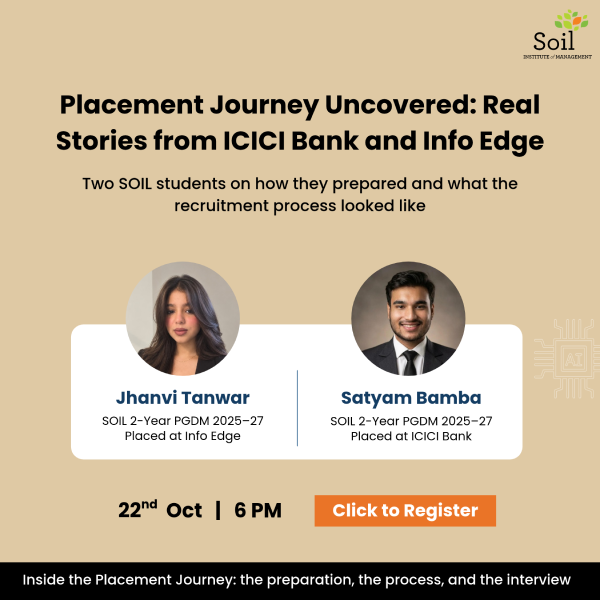
Webinar - Placement Journey Uncovered: Real Stories from ICICI Bank and Info Edge
Posts By
  • Admissions Office
  • Faculty Desk
  • Industry Insights
  • Innovation & Design Thinking
  • Leadership & Management
  • PGDM
  • Student Careers
  • Student Journey
  • Student Life
Topics
  • 1 Year MBA
  • 2 Year MBA
  • Admissions
  • Analytics
  • B School
  • Big Data
  • Board
  • Business Design
  • Candidates
  • Career
  • Careers
  • Curriculum
  • Demand
  • Design Thinking
  • Experiences
  • Experiential Learning
  • Finance
  • Global Exchange
  • Growth
  • HR
  • Industry Network
  • International
  • Interview
  • Journey
  • Leaders speak
  • Leadership
  • Learning
  • Management
  • MBA
  • MBA in HR
  • MBA in Human Resource Management
  • One Year Full Time MBA Program
  • One Year MBA
  • One Year MBA in India
  • Opportunities
  • Part time programs
  • Personal Interview
  • PGDM
  • PGDM in Business Design
  • PGPM
  • PGPM - Human Resource
  • PGPM HR
  • Placements
  • Post Graduate Diploma in Management
  • Post Graduate Diploma in Management in Business Design
  • Post Graduate Program in Management
  • Post Graduate Program In Management - Human Resource
  • Pre MBA
  • Preparation
  • Ranking
  • Skills
  • SOIL Days
  • Specialization
  • Technology
  • Transformation
  • Two Year MBA
  • Two Year MBA in India
Audience
  • 1 Year MBA
  • 2 Year MBA
  • Corporates
  • Executive Programs
  • HR
  • HR Programs
  • Part Time Programs
  • PGDM
  • PGPM
Industry
  • Analytics
  • Education
  • Finance
  • HR
Year
  • 2026
  • 2025
  • 2024
  • 2023
  • 2022
  • 2021
  • 2020
  • 2019
  • 2018
  • 2016
  • 2015
  • 2014
Popular Posts
12 Tips To Apply At Soil – From The Pgdm Director For Admissions

12 Tips To Apply At Soil – From The Pgdm Director For Admissions

Read More
MBA vs. PGDM: Understanding the Difference

MBA vs. PGDM: Understanding the Difference

Read More
One Year MBA in India

One Year MBA in India

Read More
What Is The Future Of Design Thinking In Business?

What Is The Future Of Design Thinking In Business?

Read More
PGPM Vs PGDM: Which One Should You Opt For

PGPM Vs PGDM: Which One Should You Opt For

Read More
  • AI skills for MBA students: What employers will expect from future business managers

    5 Oct 2026
    • admin
    Share

    If AI can already handle parts of a manager’s work, what will employers expect MBA graduates to bring to the table post 2026?

    AI can now handle parts of information gathering, analysis and first drafts in minutes.

    For MBA students entering the job market, that shift is already changing which skills matter. AI skills for MBA students go beyond knowing a few AI tools. The understanding of where AI can actually help with their work, check what it produces and make the final call themselves.

    The real shift: from doing the work to directing the work

    AI does not simply add another tool to an MBA student’s toolkit. It changes where their time goes.

    Accenture offers a real-world example. Its marketing team uses AI agents for research, analytics and forecasting. A research task that once took marketers up to two days can now produce a summary within seconds. An initial campaign strategy brief that took up to three weeks can now be drafted in minutes.

    directing_the_work ai article

    Consider a market research assignment.

    Earlier, a student might spend hours collecting information, cleaning it and preparing a summary. With AI, much of that first-pass work can happen faster.

    The workflow now looks different:

    Define the problem → prompt the tool → check the evidence → interpret the output → make the decision.

    Each step needs a different capability.

    A weak AI user asks for an answer.

    A stronger business user gives the tool context, tests its assumptions and checks the evidence.

    The difference is not the AI tool. It is the quality of the thinking around it.

    That is why AI literacy for MBA students should be treated as a business skill, not a software skill.

    Where do AI skills for MBA graduates fit in management work?

    Employers are beginning to place more value on AI skills alongside traditional management capabilities. 

    GMAC’s 2025 Corporate Recruiters Survey found that 31% of global employers considered knowledge of using AI tools important when hiring graduate management education candidates. That figure was 26% in 2024.

    employer_expectations ai article

    Looking five years ahead, employers placed skills using AI tools first among the capabilities they expected to value most. Strategic thinking and problem-solving remained among the leading skills.

    The survey also shows where employers expect AI to be used. Among employers who already considered AI important, 63% selected developing business strategy and making decisions as an important use of AI tools. Conducting research accounted for 51%, while 41% selected using AI ethically.

    The World Economic Forum’s Future of Jobs Report points in a similar direction. AI and big data rank among the fastest-growing skills, while analytical thinking remains the most sought-after core skill.

    Learning an AI tool is one skill. Knowing when to use it, checking its output and applying it to a business decision is another.

    What AI skills should MBA students learn?

    MBA students can use AI for research, analysis and everyday business tasks.

    T1_core_ai_skills

    The real test comes when students apply these skills to a business problem. For example, a marketing student could ask AI to suggest a launch strategy. A better prompt would include the target customer, price range, market, competitors, budget and business goal. The student can then check whether the suggestions fit the available evidence.

    questions_before_trust

    The same approach applies to learning AI skills. MBA students do not need to start with coding. They can build from the skills they already use in business school, then add tools such as AI, SQL and data visualisation. Python becomes useful for students whose work involves more technical analysis.

    learning_path ai article

    Your career paths also determine technical skills needed. Some roles like product management may require more technical analysis than other fields.

    T2_skills_by_career

    Across these roles, AI changes how familiar MBA skills are applied. These are also important AI skills for management students, regardless of their career path.

    T3_new_mba_skill_stack

    An AI-generated result is not automatically ready to use. Responsible use also forms part of these skills. Privacy, bias, intellectual property and sensitive business information can all affect how AI should be used.

    How can MBA students use AI in business? 

    T4_ai_in_business_tasks

    Do MBA students need coding skills for AI? 

    Not every MBA student needs to learn coding to work effectively with AI.

    Many business tasks can use AI tools without writing code. The right AI tools for MBA students depend on the task and career path.

    Students can use AI for research, analysis, presentations, customer insights and business communication.

    These applications mainly require task definition, data awareness and output evaluation.OECD research also suggests that most workers will need data and digital skills rather than advanced AI skills.

    Coding becomes more relevant when the role involves technical data work or building AI-based applications. Students working with large datasets may benefit from Python or SQL.

    Those interested in product management may also benefit from understanding how AI systems connect with software and data. AI for MBA graduates is less about coding and more about applying AI to practical business problems.

    How can you demonstrate AI skills?How can you demonstrate AI skills?

    A market research project, for example, can show how AI was used to gather and organise information. The project should show which sources were used and how the findings were checked.

    A data analysis project can show how AI helped examine a dataset or identify patterns. The student can explain what they asked the AI, which findings they used and how they reached their conclusion.

    Case competitions, internships and academic projects offer other opportunities to use AI. The business problem should stay at the centre. A strong project can document:

    • The business problem being addressed
    • The data or sources used
    • Where AI supported the work
    • How the output was checked
    • What decisions followed from the analysis
    • What limitations remained

    It shows how the student applies AI within a business task and where human judgement remains necessary.

    How can MBA students use AI automation?

    For example, a sales team could use AI to classify enquiries, extract customer details, draft responses and prepare a weekly summary.

    Reckitt offers a useful example of AI-assisted commercial decision-making. The company uses AI and data to analyse pricing, promotions and assortment. Its teams can also test different scenarios before making commercial decisions.

    For an MBA student, the lesson is simple: AI can produce analysis at speed, but managers still need to assess the assumptions, trade-offs and business context behind a recommendation.

    Managers still need to decide which tasks should be automated, where human review is needed and how the results should be measured.

    AI literacy also changes how MBA students should question an answer.

    Instead of asking only whether an AI response sounds convincing, students can ask what assumptions support it, what evidence is missing and what could make the recommendation wrong.

    For example, an AI-generated pricing strategy may look sensible. But the recommendation could change if customer demand, competitor pricing or margins differ from the assumptions used.

    The skill is not just getting a better answer from AI. It is knowing when the answer should not be trusted.

    What should MBA students consider when developing AI skills?

    Start with business tasks. Identify where AI could support research, analysis, communication or decision-making.

    Learn to check AI output. AI can produce inaccurate information or miss important context. Verify sources, review assumptions and question results before using them.

    Build data skills. Basic data analysis can help students understand what AI tools produce. It also makes it easier to identify weak conclusions or misleading patterns.

    Understand responsible use. Students should know how privacy, intellectual property, bias and sensitive data can affect AI use in business settings.

    Match technical depth to career goals. A marketing student may need different technical skills from someone pursuing product management or finance. Coding can become more useful as the work becomes more technical.

    AI skills for MBA students

    AI skills for MBA students is becoming part of everyday management work. For MBA students, that means learning how to use AI for research, analysis and other business tasks.

    The technical skills will depend on the role. Marketing may involve customer analysis and campaign data. Finance may involve forecasting and financial modelling. Product roles may require more knowledge of data and AI systems.

    Getting an answer from AI is only part of the process. Students still need to check the information, question the assumptions and decide whether the answer holds up. That judgement remains an important part of management work.

    FAQs
    • What AI skills are useful for MBA jobs?

      AI skills for MBA jobs include research, data analysis, prompt writing and output evaluation. The skills required vary across marketing, finance, consulting, operations and product management.

    • Do MBA students need coding skills for AI?

      MBA students do not need coding skills for most business applications of AI. Python or SQL can be useful for roles involving data, technology or product management.

    • How can MBA students develop AI skills?

      MBA students can develop AI skills through academic projects, internships and case competitions. These activities can help them apply AI to practical business problems.

    • How can MBA students demonstrate AI skills?

      Projects can show how students apply AI to practical business tasks. They can explain the sources used, checks performed and decisions that followed from the analysis.

    • What should MBA students know about responsible AI use?

      They should understand issues such as privacy, bias, intellectual property and the use of sensitive data and what AI-generated information needs human review.

    • Do AI skills replace traditional MBA skills?

      AI skills add to the skills used in management work. Analytical thinking, business knowledge and judgement help managers assess AI outputs and decide how to use them.

    About the Author

    Arindam Mukherjee

    Arindam Mukherjee Professor of Practice – Marketing, National Head,
    Hindustan Times, FMS Delhi

    Arindam Mukherjee is a Professor of Practice in Marketing at SOIL Institute of Management with over 30 years of industry experience. He has worked with leading companies such as Asian Paints, Coca-Cola, Gillette, Dabur, Wrigley, and Hindustan Times Media. His expertise includes marketing, brand management, sales, distribution, and business development. He has also held senior leadership roles in the FMCG, media, and education sectors.

  • PGDM vs MBA: Understanding the Key Differences to Make the Right Choice Founder & Chairman Mr. Anil Sachdev PGPM vs PGDM: Key differences to choose best path for your management career
Didn't Find What you Were Looking For?
Never miss a beat. Get Blog updates regularly in your inbox
[email-subscribers-form id="1"]
X

Post navigation

Previous Previous post: MBA in the Age of AI: What Should Students Look for in an MBA program?
About Us
  • About
  • Spirituality
  • Founder Message
  • Accreditation & Associations
  • Industry Consortium
  • Leadership
  • Media
  • Global Partnerships
  • Annual Events
  • Jobs@SOIL
Academic Programs
  • PGPM
  • PGPM HR
  • PGDM
  • Executive Education & Consulting
Faculty & Staff
  • Faculty Members
  • International Publications
  • Books Written
  • Conferences
Centers
  • Center for Entrepreneurship
  • Center for Social Innovation
  • Center for Leadership & Human Values
  • Center of Design Thinking and Innovation
SOIL Alumni Portal
SOBD Alumni Portal
Blogs
Contact Us
SOIL

Legal Entity Name - Inspired Leadership Gurukul, Plot 76, Sector 44, Gurgaon, Haryana, India - 122003
Campus Address (PGDM): Plot No. 23, Sector 02, Phase 01, Manesar, Gurgaon, Haryana – 122050 Phone – 9717280018 / 9870256660

SOIL

Legal Entity Name - Grow Talent Company Limited, Plot 76, Sector 44, Gurgaon, Haryana, India - 122003
Phone – 9205333417 / 9289270707

whatsapp imunify-bot-check